
From AI Adoption to Agentic Experience

For the past two years, most conversations about AI in software engineering have focused on adoption.
How many developers are using AI? How many Copilot licenses are active? How many prompts are generated each day? How many lines of code are being produced? These metrics are easy to collect, easy to benchmark, and easy to present to leadership.
The problem is that they answer only one question: Is AI being used? Increasingly, that is no longer the interesting question.
Across the engineering organizations we work with, AI adoption is rarely the primary challenge anymore. Most teams have already crossed that threshold. Developers are experimenting. AI tools are integrated into daily workflows. Engineering leaders are seeing measurable productivity gains.
The more interesting question is: What happens after adoption? Because software delivery is not simply the act of generating code. Software delivery is the ability to generate, understand, review, validate, test, maintain, and evolve code over time. And this is where a new pattern is emerging.
The Organizations We Work With Do Not Have an AI Adoption Problem
Over the past year, we’ve analyzed AI-related Developer Experience data across hundreds of engineers. One finding appears consistently. Developers are not resisting AI. In fact, most engineering organizations show similar patterns:
- strong experimentation,
- high willingness to use AI,
- widespread workflow integration,
- meaningful productivity gains.
When asked about AI’s impact on their work, engineers frequently describe substantial time savings. A recurring pattern emerges: Developers commonly report saving several hours per week through AI-assisted work.
At first glance, this looks exactly like the productivity story many organizations hoped for. But when we ask a second question, the picture becomes much more interesting.
The Question Most Organizations Aren’t Measuring
Alongside time savings, we, with the DevEx AI, ask engineers a second question: How much time do you spend reviewing, validating, correcting, or reworking AI-generated output?
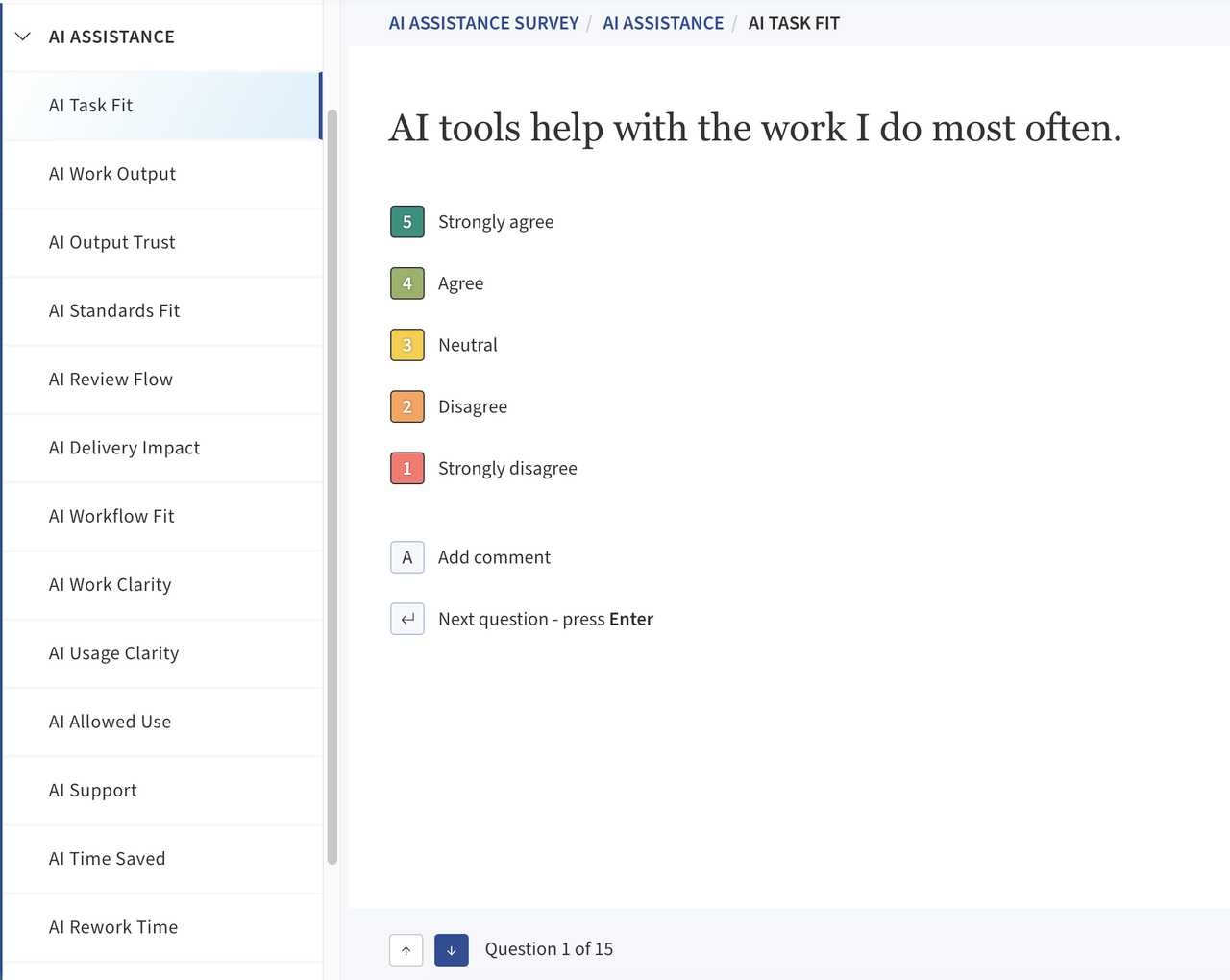
The answers reveal one of the most important dynamics in AI-assisted engineering. While engineers consistently report significant time savings through AI, they also report spending a substantial amount of time reviewing and validating generated work.
In one recent study, engineers reported approximately five hours of weekly productivity gains through AI assistance, while spending approximately three hours per week reviewing, correcting, and reworking generated output.
The specific numbers vary between organizations. The pattern does not. AI generates value. But a meaningful portion of that value is consumed downstream.
The Most Common AI Problem Isn’t Generation
When people discuss AI risks, they often focus on hallucinations or incorrect code. Those issues exist. But they are not the dominant pattern we see. Across organizations, engineers rarely complain about AI’s ability to produce code. Instead, they repeatedly describe problems that emerge later in the delivery process.
Writing the code is faster, but checking it, testing manually, and code review are much more time consuming.
The challenge is no longer generation. The challenge is absorption.
AI Is Changing Where Engineering Bottlenecks Exist
For decades, software delivery was constrained primarily by implementation effort. Writing software was expensive. AI fundamentally changes that equation.
We have explored this shift in more detail before. As AI makes implementation dramatically cheaper, engineering constraints don’t disappear—they move. Review, validation, coordination, and comprehension increasingly become the factors limiting delivery performance.
Across organizations, engineers repeatedly describe the same phenomenon: AI can generate large amounts of implementation work incredibly quickly.
This may be one of the defining characteristics of AI-native engineering. As code generation becomes cheaper, teams naturally attempt larger changes. But review capacity does not increase at the same rate.
Human attention remains limited, human understanding remains limited, trust remains limited.
The result is a growing mismatch between generation speed and organizational absorption capacity.
We’ve observed this pattern repeatedly. AI scales implementation capacity much faster than it scales alignment, coordination, or shared understanding. As a result, teams often discover that generating software is no longer the difficult part—staying aligned around the generated software is.
Trust Turns Out to Be a Delivery-System Problem
Another recurring pattern involves trust. Many discussions about AI assume trust is primarily determined by model quality. The engineers we speak with tell a different story. Trust is often determined by workflow design. AI tends to be trusted when:
- tasks are clearly defined,
- requirements are stable,
- scope remains bounded,
- generated changes stay understandable.
Trust deteriorates when those conditions disappear.
It’s not about code quality. It’s about comprehension. The moment engineers stop understanding generated work, trust begins to erode.
This creates a new form of technical debt. The issue is not necessarily incorrect code. The issue is code that exists faster than engineers can build sufficient understanding around it. We increasingly see organizations accumulating what can be described as comprehension debt.
A New Layer of Developer Experience Is Emerging
As we compared patterns across organizations, one conclusion became increasingly difficult to ignore. Traditional AI metrics explain very little about delivery outcomes.
This observation closely mirrors findings emerging from the DORA research. AI acts primarily as an amplifier. Organizations with strong engineering capabilities often see accelerated outcomes. Organizations with weak review, planning, or coordination capabilities frequently see those weaknesses amplified as well.
License utilization does not explain review overload. Prompt counts do not explain trust. Usage statistics do not explain rework. Instead, we see a broader phenomenon emerging.
The quality of interaction between:
- engineers,
- AI agents,
- review processes,
- delivery workflows,
- organizational standards,
has become a significant factor in engineering performance. We refer to this as Agentic Experience. Agentic Experience is not a measure of model capability. It is a measure of how effectively AI-generated work flows through an engineering system.
One way to think about Agentic Experience is that engineering work is moving “up the stack.” Less time is spent on mechanical implementation and more time is spent on architecture, validation, coordination, decision-making, and sense-making around generated work.
High Agentic Experience exists when generated work remains:
- understandable,
- reviewable,
- trustworthy,
- maintainable,
- and easy to integrate into delivery workflows.
Low Agentic Experience emerges when AI generates work faster than humans can safely absorb it.
The Next Frontier Is Not Adoption
For the past two years, most organizations have focused on one goal: increasing AI adoption. That made sense. The first challenge was getting engineers to experiment with AI, integrate it into their workflows, and discover where it could create value. Today, that challenge is rapidly disappearing.
Across the engineering organizations we work with, developers are already using AI. They are generating code, accelerating implementation, exploring new workflows, and reporting meaningful productivity gains.
The organizations seeing the greatest value from AI are no longer asking: How do we get more engineers to use AI?
Instead, they are asking a much more important question: How do we preserve more of the value AI already creates? This is where the next phase of AI maturity begins. Because AI does not operate in isolation.
Every AI-generated change still needs to move through the rest of the engineering system:
- review,
- validation,
- testing,
- coordination,
- deployment,
- maintenance.
And increasingly, this is where organizations discover their next constraint, an emerging paradox: Coding becomes faster while delivery does not.
Teams successfully accelerate implementation but continue to struggle with review, validation, testing, coordination, and deployment. This is often the first visible signal that AI adoption has outpaced delivery-system adaptation.
The challenge is no longer generating software.
The challenge is helping organizations safely absorb the software that AI generates.
This is why many teams report a strange experience. Developers feel more productive than ever, yet delivery performance improves far less than expected. Individual work accelerates, but system-level outcomes improve only modestly.
The reason is simple. AI has changed the economics of software delivery.
For decades, engineering organizations optimized implementation because implementation was expensive. Today, implementation is becoming dramatically cheaper. Reviewability, comprehension, trust, and coordination are becoming scarce resources instead.
This is precisely why we believe a new dimension of Developer Experience is emerging. One that focuses not only on how effectively developers work with tools, but on how effectively human and AI work flows through the delivery system - Agentic Experience.
The organizations that succeed in the next phase of AI transformation will not necessarily be the ones with the highest adoption rates or the most advanced models. They will be the organizations that build delivery systems capable of turning AI-generated output into trusted, reviewable, maintainable, and deployable software. Because the next frontier is no longer AI adoption. It is AI-native delivery.
And increasingly, the difference between the two is Agentic Experience.

