
Specification Clarity: DevEx Survey Questions to Unblock Teams Stuck Between Ideas and Code

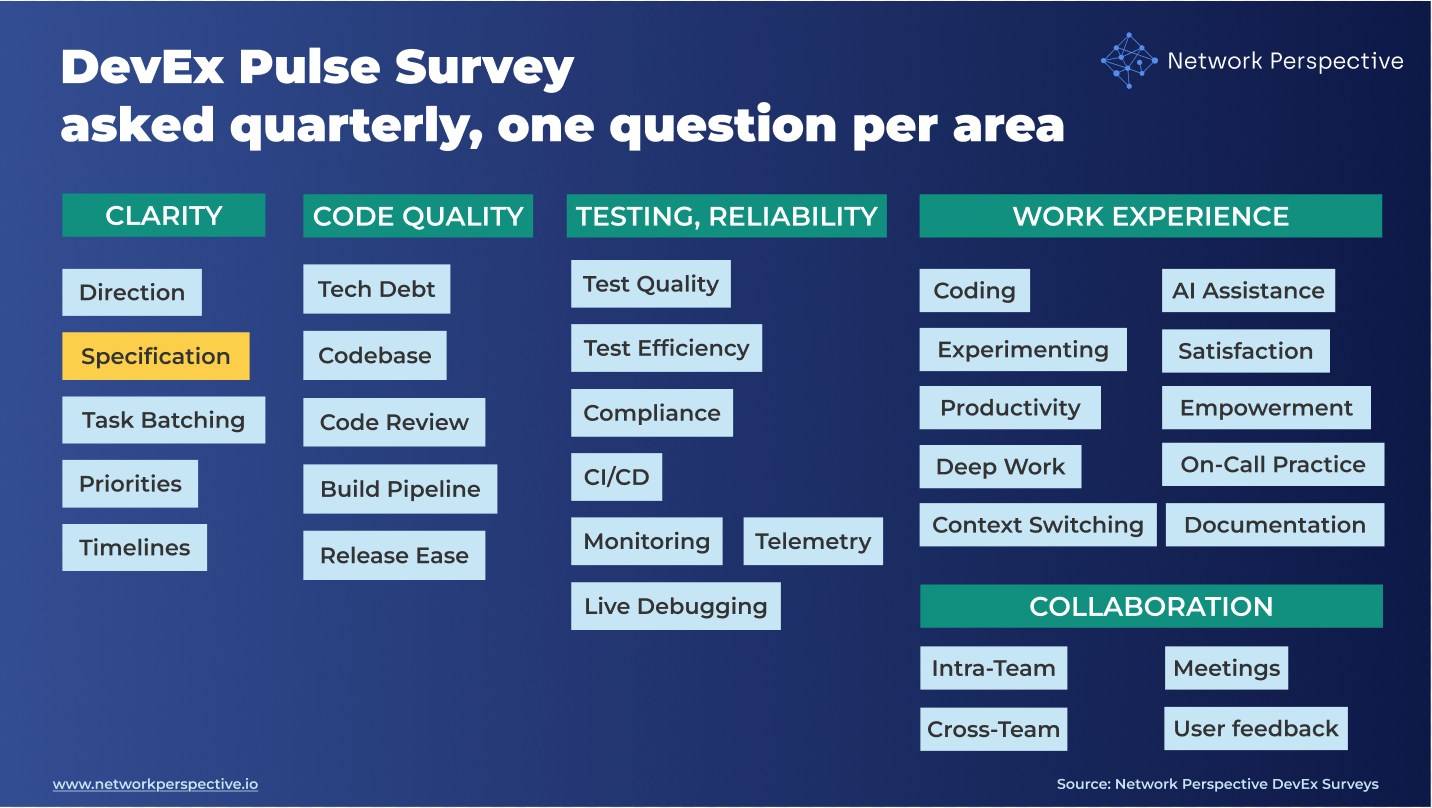
In our DevEx AI tool, we use two sets of survey questions: DevEx Pulse (one question per area to track overall delivery performance) and DevEx Deep Dive (a focused root-cause diagnostic when something needs attention).
DevEx Pulse tells us where friction is. DevEx Deep Dive tells us why it exists.
Let’s take a closer look at Specification. If the Pulse question “Project and task specifications are clear and well-defined” receives low scores and developers’ comments reveal significant friction and blockers, what should you do next?
Here are 10 deep dive questions you can ask your developers to uncover the causes of poor specification clarity, along with guidance on how to interpret the results, common patterns engineering teams encounter, and practical first steps for improvement. This will help you pinpoint what’s causing the problem and fix it on your own, or move faster with our DevEx AI tool and expert guidance.
Specification Clarity — DevEx Survey Questions for Engineering Teams
The real question is: Do we start with enough clarity, or figure it out while building and pay later?
Deep dive questions should help you map how specification clarity flows through your delivery process and identify where it breaks down:
Meaning → Direction→ Readiness→ Authority→ System Awareness→ Time Integrity→ Cost
Here’s how the DevEx AI tool helps uncover this.
Early Clarity
What was unclear too late? – open ended question
Info / What was unclear or changed after work had already started?
Why & Done
Do we know what we’re building and what “done” means?
- Problem / I understand the problem this work is solving.
- Done / It’s clear what a successful outcome looks like.
Enough to Start
Can we start without guessing?
- Detail / There’s enough detail to start work.
- No gaps / Work can start without major gaps or assumptions.
Stability
Once we start, does it mostly stay the same?
- Stable / Requirements don’t change a lot after work has started.
- Explained / When things change, it’s explained what changed and why.
Decisions
Do we know what’s already decided before we start?
- Clear / The key decisions needed to start are clear.
- Owner / It’s clear who decides when questions come up.
Impact
Do we know who this might affect before we start?
- Known / We usually know who this work might affect before we start.
Effort
How much time is lost?
- Weekly / How much time do you lose each week because things weren’t clear at the start?
- None
- Less than 1 hour
- 1–2 hours
- 3–5 hours
- 6–10 hours
- More than 10 hours
Open-ended question (for comments)
Ideas to spot or reduce friction?
How to Analyze DevEx Survey Results on Requirements and Specifications
Do we start with enough clarity, or do we figure it out while building and pay later? Here’s how the DevEx AI tool helps make sense of the results.
How to Read Each Section
Early Clarity (Open-ended)
Question
- What was unclear or changed after work had already started?
What this section tests
Where clarity breaks in real life — not in theory.
It tests:
- What shows up late
- What forces rework
- What repeatedly surprises teams
- Where clarity fails upstream
Why & Done
Questions
- Problem — I understand the problem this work is solving.
- Done — It’s clear what a successful outcome looks like.
What this section test
Whether teams know:
- Why this work exists
- What success actually means
This is direction clarity.
How to read scores
Problem ↓, Done ↓
→ Work feels mechanical. Teams build tasks, not outcomes.
Problem ↑, Done ↓
→ Teams know the “why” but not what good looks like.
Problem ↓, Done ↑
→ Output is defined, but the underlying problem is unclear.
Key insight
If people don’t know the problem or what “done” means, rework is almost guaranteed.
Enough to Start
Questions
- Detail — There’s enough detail to start work.
- No gaps — Work can start without major gaps or assumptions.
What this section tests
Whether teams must guess, assume, or fill in missing pieces.
This is practical readiness.How to read scores
Detail ↓, No gaps ↓
→ Teams are building and discovering at the same time.
Detail ↑, No gaps ↓
→ Specs look detailed, but important pieces are still missing.
Detail ↓, No gaps ↑
→ Lightweight specs, but stable shared understanding.
Key insight
Guesswork today becomes rework tomorrow.
Stability
Questions
- Stable — Requirements don’t change a lot after work has started.
- Explained — When things change, it’s explained what changed and why.
What this section tests
Whether clarity survives contact with reality.
This is time stability.
How to read scores
Stable ↓, Explained ↓
→ Chaos. Work shifts without explanation.
Stable ↓, Explained ↑
→ Change is frequent but at least visible.
Stable ↑, Explained ↓
→ Rare change, but confusing when it happens.
Key insight
Change is normal. Unexplained change creates frustration and waste.
Decisions
Questions
- Clear — The key decisions needed to start are clear.
- Owner — It’s clear who decides when questions come up.
What this section tests
Whether ambiguity gets absorbed by development.
This is decision clarity.
How to read scores
Clear ↓, Owner ↓
→ Development becomes the decision-maker by default.
Clear ↑, Owner ↓
→ Decisions exist, but no clear authority to resolve new ones.
Clear ↓, Owner ↑
→ Authority exists, but decisions are not prepared in advance.
Key insight
Unmade decisions don’t disappear — they move downstream.
Impact
Question
- Known — We usually know who this work might affect before we start.
What this section tests
Whether clarity is local or broader.
This is impact awareness.
How to read scores
Known ↓
→ Cross-team impact discovered late.
Known ↑
→ Broader thinking exists before starting.
Key insight
Local clarity is not enough if impact is discovered later.
Effort
Question
- Weekly - How much time do you lose each week because things weren’t clear at the start?
What this section tests
The real economic cost of unclear specs.
How to read scores
0–1 hr → Minor friction.
1–3 hrs→ Noticeable but manageable.
3–5 hrs→ Structural clarity issue.
6+ hrs→ Clarity failure is a system problem.
Key insight
Hours lost are the most honest metric in the survey.
Open-ended Question (Comments)
Ideas to spot or reduce friction?
How to read responses
Look for:
- Process suggestions → “We need earlier review.”
- Role clarity → “Someone should decide X before sprint.”
- Structure → “Definition of ready is unclear.”
- Tooling → “No single source of truth.”
Key insight
If suggestions repeat, people already know where to fix it.
Pattern Reading (Across Sections)
Pattern — “Build to Discover” (Very Common)
Why & Done ↓
Enough to Start ↓
Effort ↑
Interpretation:
Work starts before clarity exists.
Pattern — “Shifting Ground”
Stability ↓
Effort ↑
Interpretation:
The main problem isn’t starting — it’s constant change.
Pattern — “Decision Vacuum”
Decisions ↓
Stability ↓
Enough to Start ↓
Interpretation:
Unmade decisions move into development.
Pattern — “Local Clarity Only”
Why & Done ↑
Impact ↓
Interpretation:
Team understands the task, but not system consequences.
How to Read Contradictions (This Is Where Insight Is)
Contradiction 1
Detail ↑ but Effort ↑
→ Specs look detailed, but detail ≠ clarity.
Contradiction 2
Stable ↑ but Enough to Start ↓
→ Work doesn’t change much, but starts too early.
Contradiction 3
Owner ↑ but Clear ↓
→ Authority exists, but decisions aren’t prepared early.
Contradiction 4
Why & Done ↑ but Stability ↓
→ Clear intent, but unstable priorities upstream.
Final Guidance — How to Present Results
What NOT to say
- “Specs are bad.”
- “Business changes too much.”
- “Developers complain.”
- “We need more documentation.”
Those statements trigger defensiveness.
What TO say (use this framing)
“This shows where clarity breaks — before we start, while we work, or after changes.”
“We are not measuring documentation quality. We are measuring how often teams must guess.”
“The cost is not confusion — it’s time lost every week.”
One Powerful Way to Present Results
Show only three things:
- Enough to Start score
- Stability score
- Weekly time lost
Then say: “If we improve clarity before starting, we reduce weekly rework hours.”
Everything else explains those three numbers.
Using DevEx Specification Clarity Insights to Reduce Ambiguity and Rework
Here’s how the DevEx AI tool will guide you toward making first actions.
First Steps Per Section
Early Clarity
Problem: Things become clear only after work has started.
First Step:
Create a simple recurring ritual:
“What did we realize too late this sprint?”
Do this at the end of every sprint for 4 weeks.
Then:
- Categorize answers (missing problem / unclear done / missing dependency / missing decision / late change).
- Fix the most frequent category only.
Small rule:
If the same “late realization” appears twice → add one upstream check for it.
No templates yet. Just pattern detection.
Why & Done
Problem: Teams build tasks, not outcomes.
First Step:
Before work starts, add one line:
- “This work matters because…”
- “We’ll know it worked when…”
If those two sentences are hard to write → the work is not ready.
Do not add documents. Add clarity in 2 sentences.
Enough to Start
Problem: Guessing at kickoff.
First Step:
Introduce a 10-minute pre-start check:
Ask the team:
“What would we be guessing about if we start now?”
If more than 2 major guesses appear → pause.
This doesn’t block agility.
It prevents avoidable rework.
Stability
Problem: Change mid-work.
First Step:
When change happens, require:
- What changed?
- Why?
- What does this replace?
That’s it.
No long process. Just make change visible.
Stability improves when change becomes explicit.
Decisions
Problem: Dev absorbs ambiguity.
First Step:
Visible decision rule:
“If this is unclear, who decides?”
Write one name per area.
When question appears → escalate immediately, not after 3 days of guessing.
Speed of decision > perfection of decision.
Impact
Problem: Late cross-team discovery.
First Step:
Add one pre-start question:
“Who could this accidentally break?”
If no one knows → that’s the signal.
No coordination meeting yet.
Just make impact thinking mandatory.
Effort
Problem: Time loss invisible.
First Step:
Track the weekly number publicly.
Do nothing else.
Just show:
“We lost 4 hours this week to unclear specs.”
Visibility alone drives behavior change.
First Steps for Patterns
Pattern — “Build to Discover”
Symptoms:
Enough to Start ↓
Effort ↑
First Step:
Introduce lightweight “Ready Enough” rule:
Must have:
- Problem sentence
- Done sentence
- Owner of open questions
That’s it.
Pattern — “Shifting Ground”
Symptoms:
Stability ↓
Effort ↑
First Step:
Separate:
- Change before start
- Change after start
If change after start → explicitly call it out as “scope shift”.
Naming change reduces hidden frustration.
Pattern — “Decision Vacuum”
Symptoms:
Decisions ↓
Stability ↓
First Step:
Create one escalation lane:
Questions unanswered > 24h → auto-escalate.
Ambiguity dies when it has a clock.
Pattern — “Local Clarity Only”
Symptoms:
Impact ↓
First Step:
Add a simple MS Teams habit:
Before starting major work:
“Heads up — this might affect X.”
No formal process yet.
Just signal early.
First Steps for Contradictions
Contradiction 1
Detail ↑ but Effort ↑
Step:
Stop adding detail.
Ask: “Which detail actually prevented rework?”
Optimize usefulness, not volume.
Contradiction 2
Stable ↑ but Enough to Start ↓
Step:
Don’t fix stability.
Fix readiness check.
Work doesn’t change much — it just starts too early.
Contradiction 3
Owner ↑ but Clear ↓
Step:
Move decision conversation earlier.
Owner exists — use them before sprint.
Contradiction 4
Why & Done ↑ but Stability ↓
Step:
Freeze goal per sprint.
Allow scope shift only between sprints.
Tiny boundary. Big effect.
The Core Improvement Rule
Clarity must move left.
Every hour of clarity added before work saves 3–5 hours later.
But:
Do not add process.
Add small decision points.
Small explicit checks > heavy governance.
The Most Powerful First Step Overall
If you can only do ONE thing:
At sprint planning, add this question:
“What would hurt most if this changes mid-sprint?”
If the answer is:
- “Architecture”
- “External team coordination”
- “User flow”
- “KPI definition”
Then clarify that first.
Why this works:
- It surfaces hidden risk
- It forces impact thinking
- It reduces late discovery
- It aligns product + tech
- It protects time integrity
One question. Huge leverage.
There’s Much More to DevEx Than Metrics
What you’ve seen here is only a small part of what the DevEx AI platform can do to improve delivery speed, quality, and ease.
If your organization struggles with fragmented metrics, unclear signals across teams, or the frustrating feeling of seeing problems without knowing what to fix, DevEx AI may be exactly what you need. Many engineering organizations operate with disconnected dashboards, conflicting interpretations of performance, and weak feedback loops — which leads to effort spent in the wrong places while real bottlenecks remain untouched.
DevEx AI brings these scattered signals into one coherent view of delivery. It focuses on the inputs that shape performance — how teams work, where friction accumulates, and what slows or accelerates progress — and translates them into clear priorities for action. You gain comparable insights across teams and tech stacks, root-cause visibility grounded in real developer experience, and guidance on where improvement efforts will have the highest impact.
At its core, DevEx AI combines targeted developer surveys with behavioral data to expose hidden friction in the delivery process. AI transforms developers’ free-text comments — often a goldmine of operational truth — into structured insights: recurring problems, root causes, and concrete actions tailored to your environment.
The platform detects patterns across teams, benchmarks results internally and against comparable organizations, and provides context-aware recommendations rather than generic best practices.
Progress on these input factors is tracked over time, enabling teams to verify that changes in ways of working are actually taking hold, while leaders maintain visibility without micromanagement. Expert guidance supports interpretation, prioritization, and the translation of insights into measurable improvements.
To understand whether these changes truly improve delivery outcomes, DevEx AI also measures DORA metrics — Deployment Frequency, Lead Time for Changes, Change Failure Rate, and Mean Time to Recovery — derived directly from repository and delivery data. These output indicators show how software performs in production and whether improvements to developer experience translate into faster, safer releases.
By combining input metrics (how work happens) with output metrics (what results are achieved), the platform creates a closed feedback loop that connects actions to outcomes, helping organizations learn what actually drives better delivery and where further improvement is needed.
Returning to our topic — specification — you can explore proven practices grounded in hundreds of interviews our team has conducted with engineering leaders.

